
The Headlines
The clearest proof of influence isn't the work. It's the colleagues who showed up unprompted when redundancy hit.
Multiple colleagues shifted into new UX disciplines. A practice I borrowed from Customer Services spread across Next and stopped the CEO in his tracks. The A/B methodology I developed became the foundation for a dedicated Optimisation team. Jon and I turned 100 innovation ideas into decision-ready trading cards that never got their audience, but shaped how I frame proposals ever since. The people I'd invested in showed up when it mattered most. That's not sentiment. That's evidence.
Two Customer Services Colleagues Who Became the Bridge Between Frontline Insight and Product Decisions.
Sonal and Arslan were in Customer Services at Next, spending their days absorbing exactly what the UX team needed most: unfiltered, real-time customer frustration. When the opportunity came to bring them into the Mobile UX team as Business Analysts, I made the case for it.
They already understood customers at a level most UX practitioners spend years trying to reach. What they needed were the frameworks to translate that knowledge into product decisions. We worked together on opportunity identification, problem framing, and representing customer needs in conversations with the wider E-Commerce department.
Both went from doubting whether they belonged in UX to confidently advocating for customers in senior meetings. The transition didn't require them to become designers. It required them to become exactly what the sub-heading says: the bridge between what customers were telling us and what we were building.
Two UI Designers Who Needed to Think Like UX Designers. Here's How That Happened.
Aneesa and Corin were talented visual designers, quick in Figma, strong eye for aesthetics. But they'd picked up habits that would hold them back: screenshotting and editing over existing UI instead of building from components, jumping straight to high-fidelity without considering the user first, and producing Figma files that were hard for anyone else to navigate.
I didn't pull rank. I designed alongside them, left asynchronous comments in their files, and gave feedback framed around practicality rather than process. Not "do it this way" but "if someone needs to pick this up next week, how easy will it be?"
Within a few months, both had shifted. Not because I'd told them to change, but because they'd understood why it mattered.
The harder challenge was helping them articulate their decisions to senior stakeholders. Both were quietly confident in their work but struggled to connect it to commercial outcomes in the room. I stepped in to translate — not to take over, but to give them cover while they found their voice.
Both have gone on to do strong work. The messages they've sent since confirm the small moments landed. That's usually how it goes.
The PMs, Developers, and Peers Who Wanted to Understand UX. I Made Time for All of Them.
Throughout my career, colleagues across disciplines, Product Managers, Developers, peers at my level, have come to me wanting to understand UX better. How to run better research. How to interpret analytics. How to push back on stakeholders without burning bridges.
I made time for it. Not out of obligation, but because the best teams aren't the ones where the UX person is the only one who cares about users. They're the ones where everyone does.
Some of the most meaningful messages I've received have come years later, and often at the moments I've needed them most. Navigating redundancy in the most difficult tech job market in a generation, colleagues I hadn't spoken to in years, to vouch for me, check in, or simply say the work had mattered. That's not something you can manufacture. It's what genuine investment in people produces.
I Borrowed an Idea From Customer Services. The CEO Stopped to Look. Other Teams Followed.
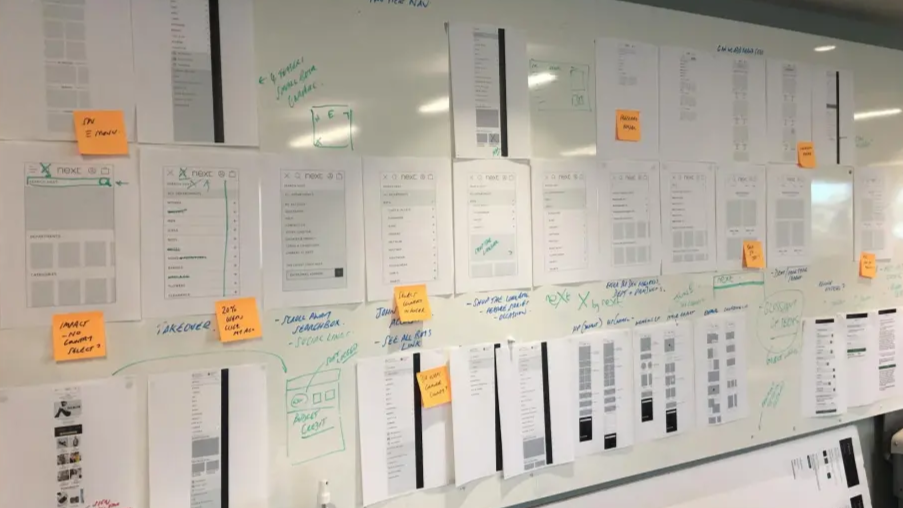
At Next's Head Office, the Customer Services team had covered their walls floor to ceiling with notes from customer calls, emails, live chat, and app reviews. A living knowledge base anyone could learn from.
I spent hours in there, reading and tallying recurring themes. Some of the sharpest insights I found at Next came from those walls, not from formal research sessions.
If it worked for Customer Services, it could work for us. I started putting UX work on the walls of high-traffic areas in our Leicester offices: competitor analyses, research findings, wireframes, and ideas we were actively testing. Not to show off, but to start conversations and demystify what the Mobile UX team actually did.
The CEO, Simon Wolfson, stopped at one of the gallery walls and asked questions about it. Other teams followed. The newly formed User Research team adopted the practice. What started as a borrowed idea became part of how Next operated.
My A/B Testing Methodology Became the Foundation for Next's Optimisation Team.
The burger menu work proved that rigorous experimentation could protect growth and challenge assumptions at the highest level. About a year later, Next established a dedicated Optimisation team to run experiments at scale.
I shared everything I'd learned with Bijal, who went on to plan and run experiments for the business. The methodology I'd developed became the foundation for how Next approached testing going forward.
The work didn't just deliver a result. It changed how the business thought about evidence.
A Visual Designer Who Wanted to Move Into Research. I Helped Her Get There.
Alanta came from a visual design and UI background but wanted to move into user research. I invited her into user interviews, both in-person and remote, and shared approaches to remote testing, competitor benchmarking, and translating analytics into insights.
She didn't just observe. She started applying it. Watching that transition happen, knowing the investment of time had accelerated it, felt as significant as delivering any project.
Jon and I Turned 100 Innovation Ideas Into Pokémon Trading Cards. Every One Was Built on Evidence.
Jon and I were both in Next's newly-formed Innovation Team. He was a Senior UX Designer; I was a Senior Mobile UX Architect. He brought deep expertise in My Account, checkout flows, and the legal and compliance intricacies of Next's credit offering. I brought extensive knowledge of browse and shop journeys across app and mobile web. Together, we had a complete picture of the customer experience.
During ad-hoc discovery sessions away from our desks, we generated over 100 innovation ideas grounded in past research and customer insight. Ideas like a Capsule Collection feature to help price-conscious shoppers build a seasonal wardrobe from a handful of essential pieces, a Drop a Hint tool for shoppers to flag wish-list items to people who struggle to buy for them, and a Showroom feature allowing shoppers to share favourites and gather honest feedback from friends and family.
Being Pokémon enthusiasts, we presented every idea as a trading card: concept name, one-line pitch, the customer insight behind it, prerequisites, which internal team was best placed to build it, KPIs targeted, estimated revenue gain, and dev effort. Over 100 cards. Instantly scannable. Everything a decision-maker needed to say yes on a single card.
Our manager chose not to present it to the Head of Ecommerce. The work never got its audience. But the discipline of making complex ideas scannable and decision-ready has shaped how I frame research and proposals ever since.
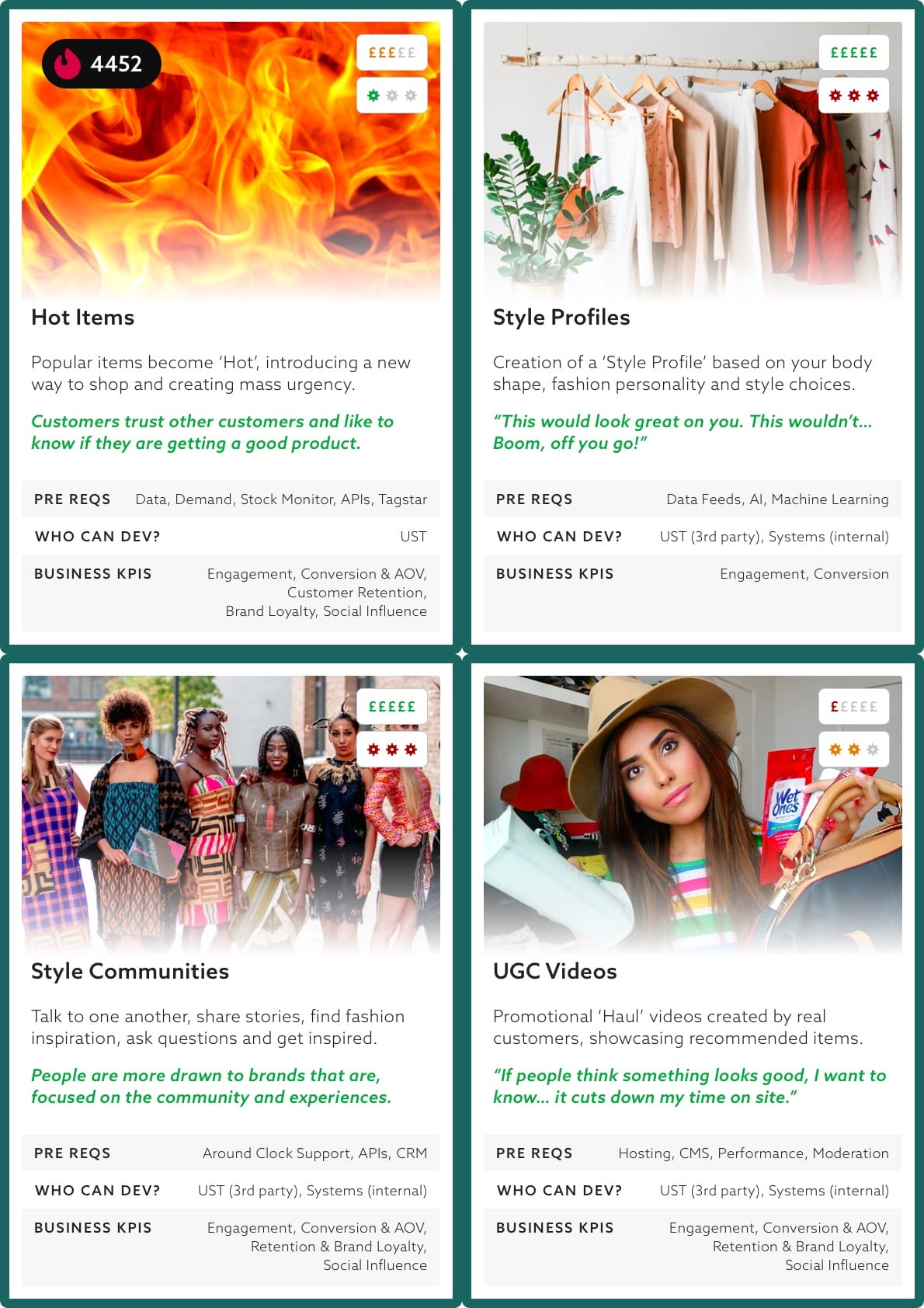
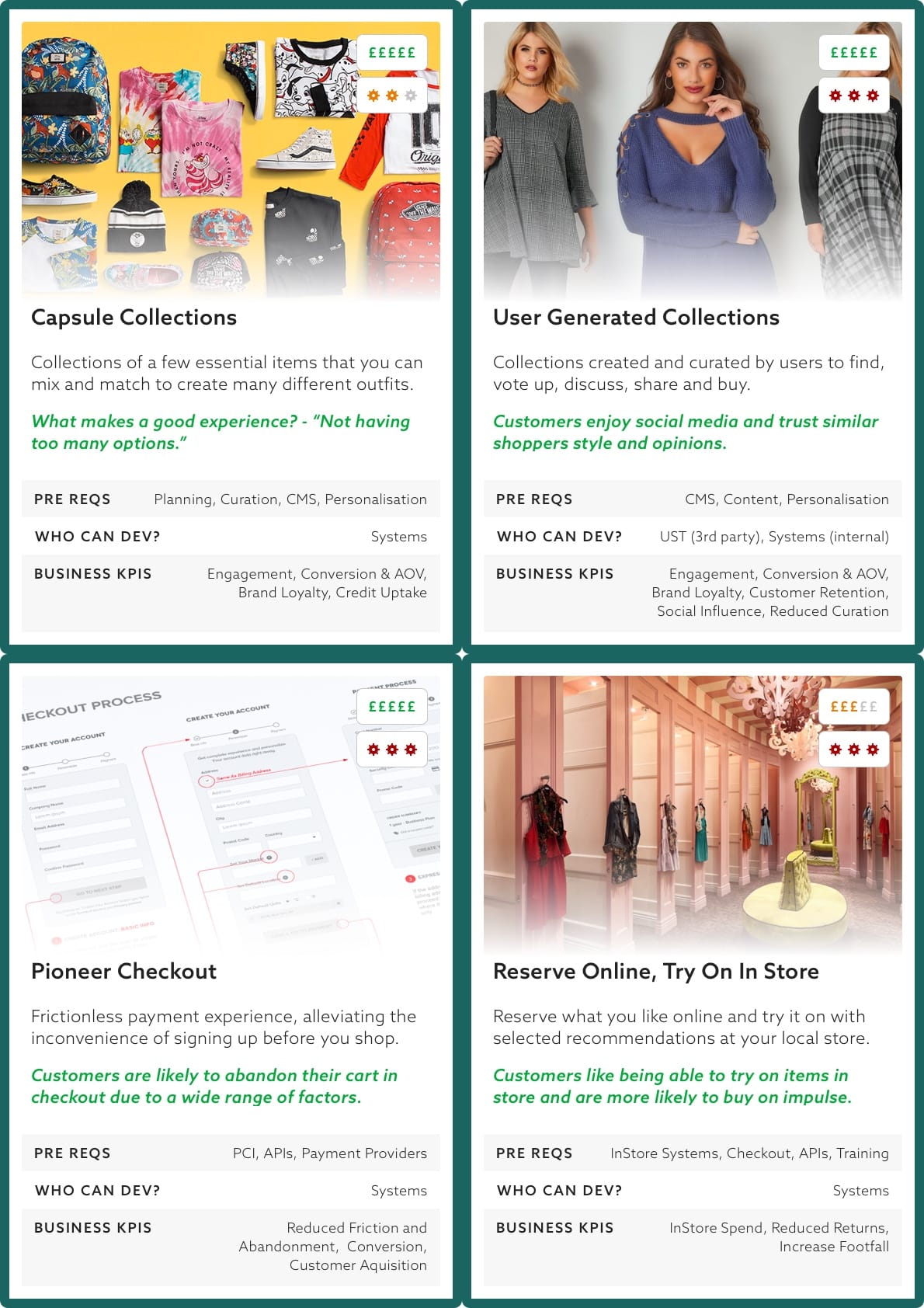
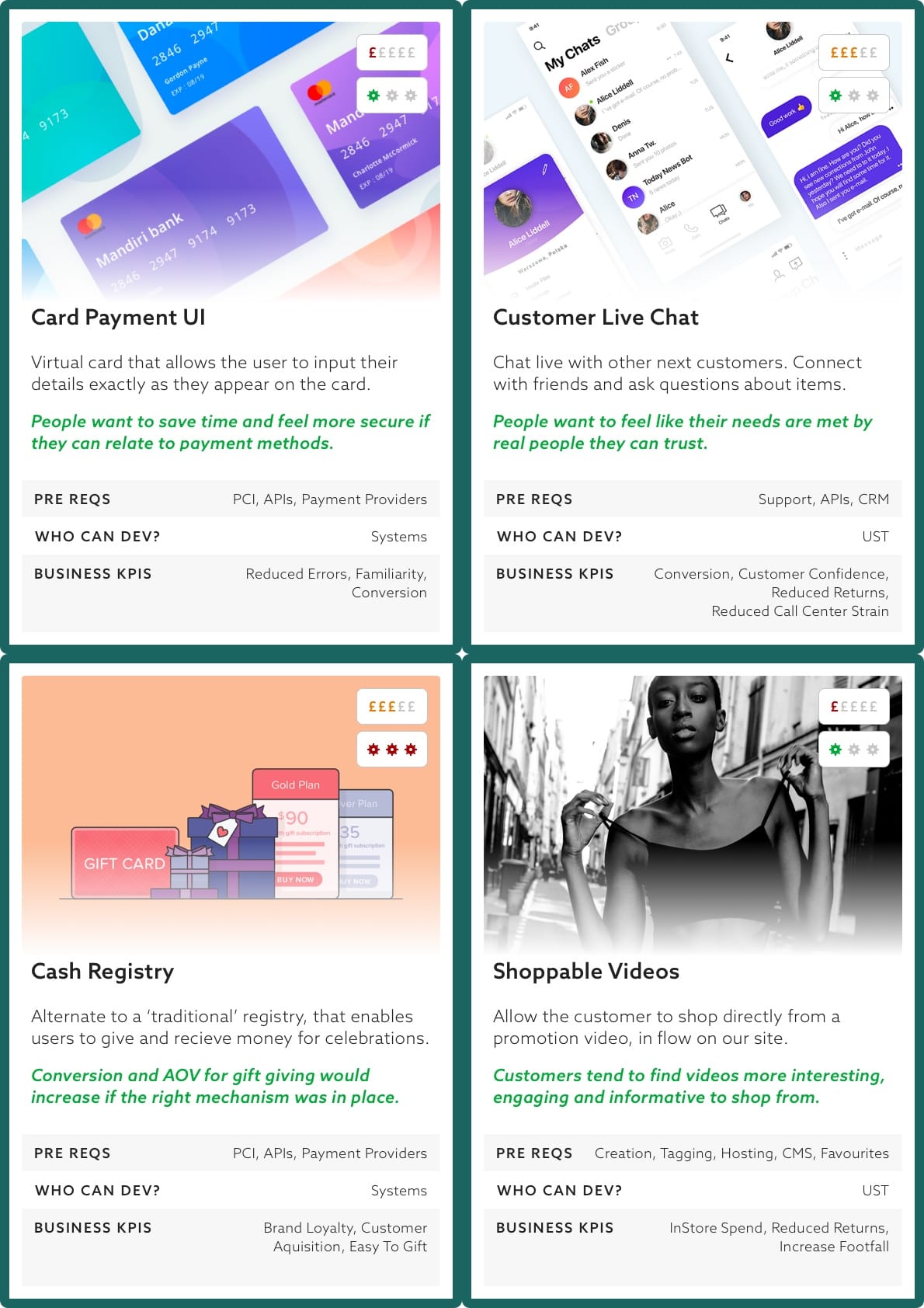
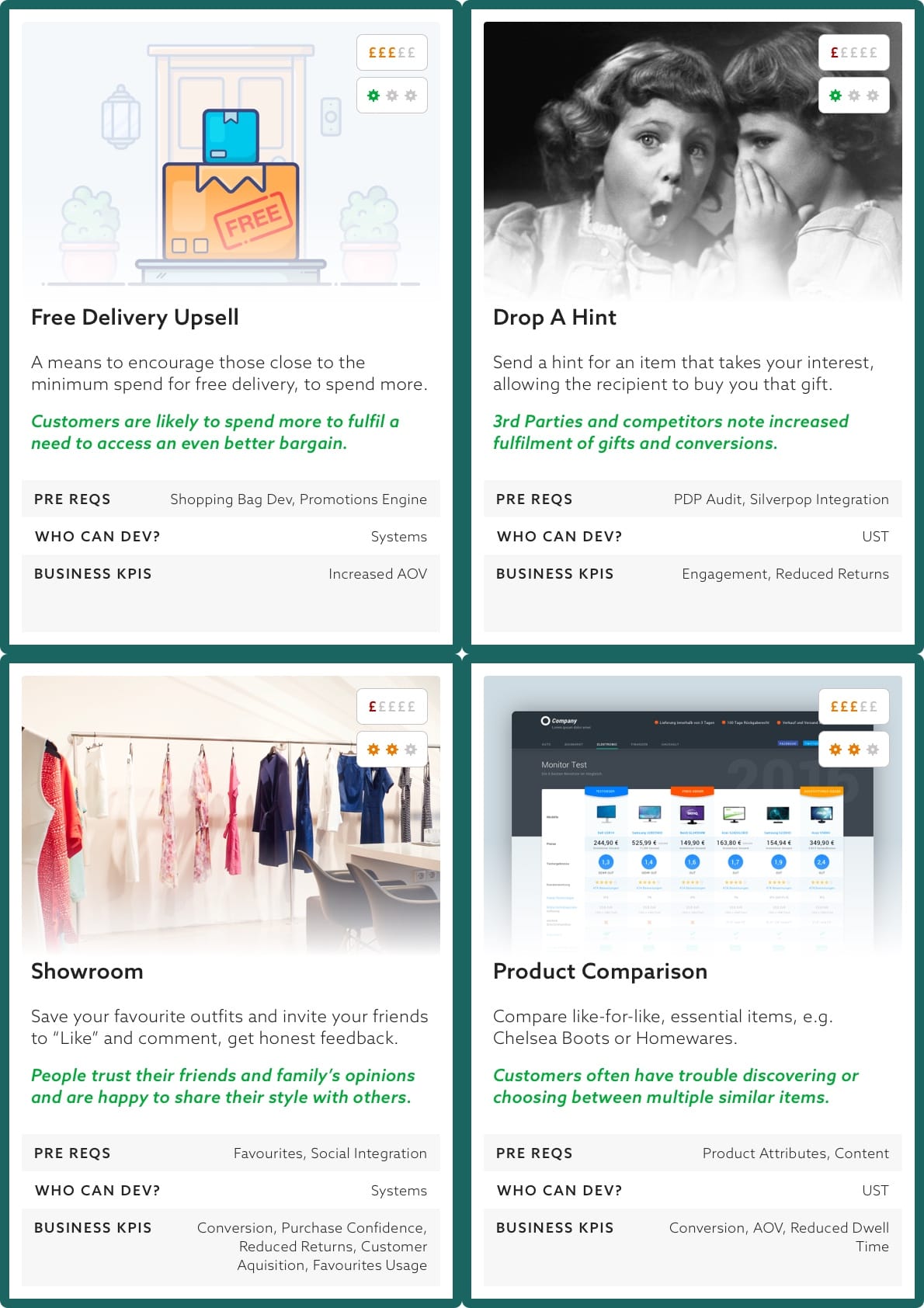
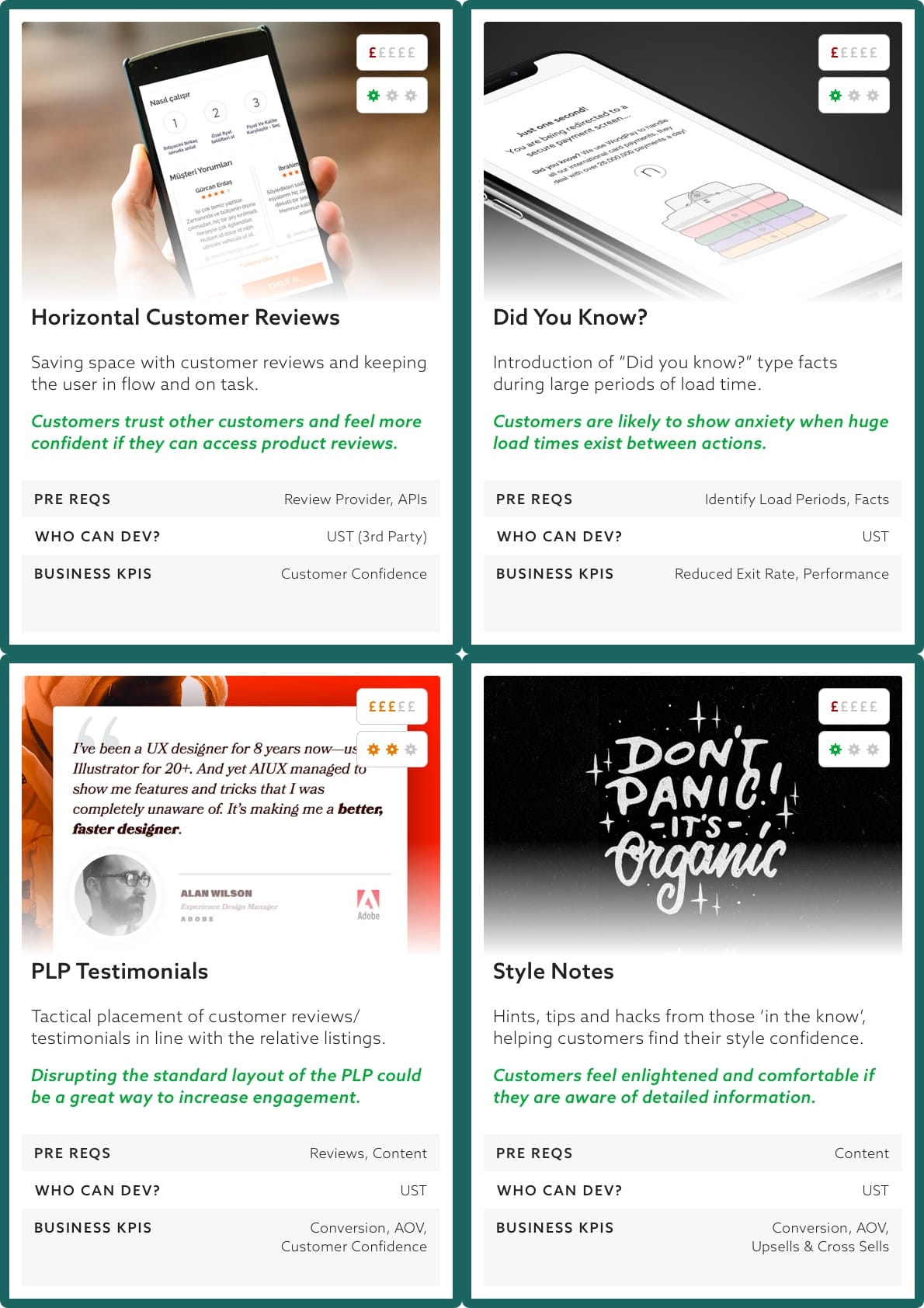
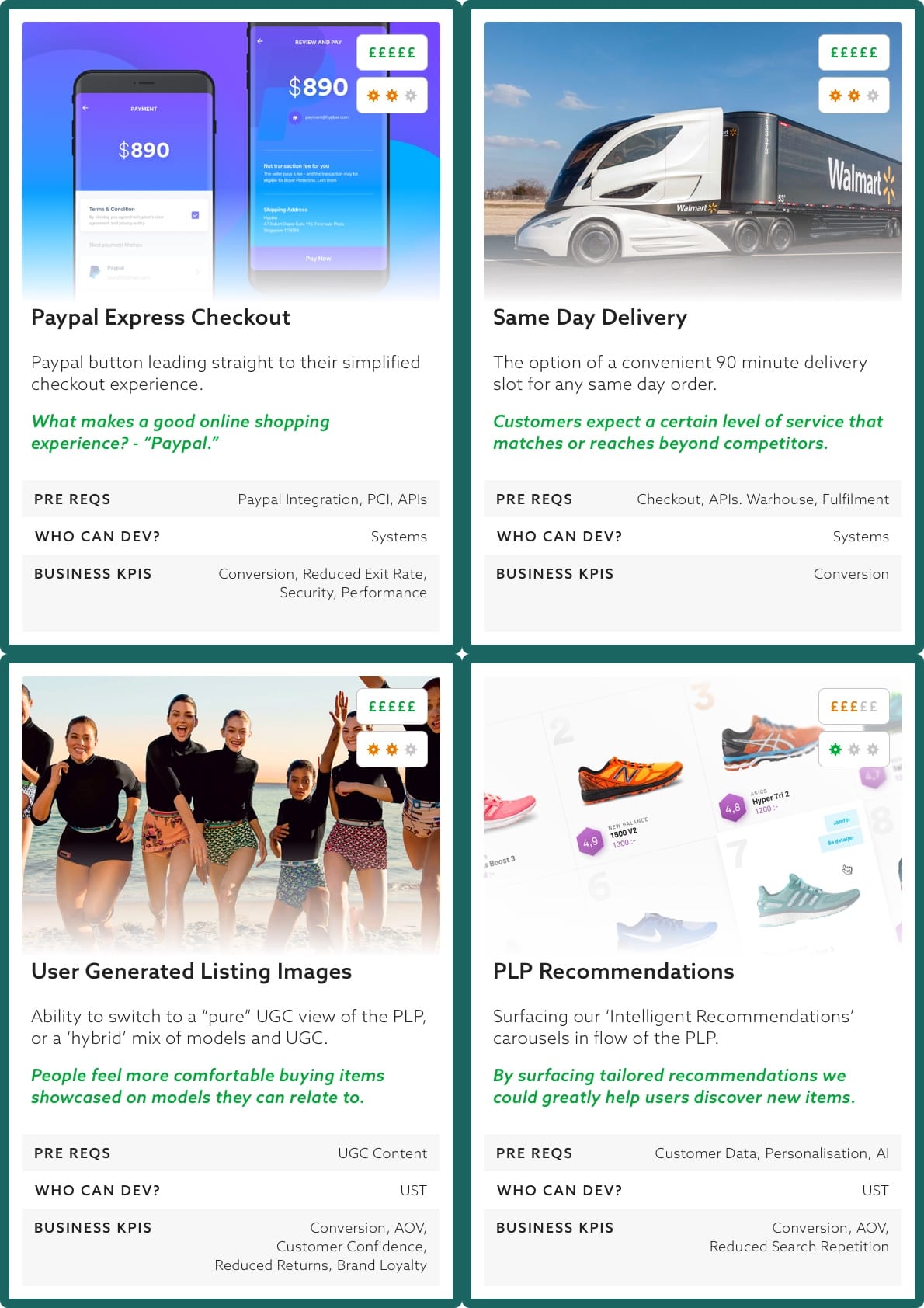
Over 100 innovation ideas. Every one built on customer insight and ready for a decision-maker. They never got their audience.
Most portfolios show you the work. This page shows you what the work produced in the people and organisations around it. Practices still running. Disciplines shifted. A methodology that became a team's foundation.
That's what IC leadership actually looks like. Not a headcount. Not a title. A body of evidence that outlasts every role it came from.